




Laying laminate flooring is one of the more straightforward DIY jobs – but getting the laminate flooring accessories right is where most people come unstuck. Buying the wrong door bar, forgetting the expansion gap covers, or using the wrong underlay for your subfloor type can all create problems after the floor is down.
This guide covers every laminate flooring accessory you need beyond the boards themselves, explains what each item does, and helps you choose the right option for your job. Tools like jigsaws, mitre saws and utility knives are separate – this guide focuses on the finishing products that go with the floor.
The Laminate Flooring Accessories You Need Before You Start
Before you start laying, make sure you have the following:
- Underlay – moisture-resistant type for concrete subfloors, foam or combination for timber
- Door bars – to finish doorway transitions between rooms or adjoining floors
- Scotia beading – to cover the expansion gap against skirting boards
- Radiator pipe covers – if you have central heating pipes coming up through the floor
- Underlay tape – to seal the joins between underlay strips (it is not the end of the world if you do not have this)
- Laminate fitting kit – includes spacers, tapping block and pull bar
Underlay
Underlay goes down before the laminate and does three things: it cushions the floor underfoot, reduces sound transmission, and provides a moisture barrier between the subfloor and the laminate above. Most laminate flooring manufacturers specify a maximum combined underlay and pre-attached backing thickness – check this before you buy. Going thicker than specified can cause the click joints to fail over time.
For concrete subfloors, always use a moisture-resistant underlay or add a separate DPM (damp proof membrane) underneath – this is a building regulations requirement on ground floors. For timber subfloors, a standard foam or combination underlay is usually sufficient.
Laminate Flooring Accessories: Door Bars Explained
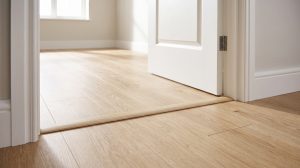
A door bar sits across a doorway where your laminate floor meets another floor. Without one, you have an exposed cut edge and an uncovered expansion gap – neither looks finished and the edge will chip over time.
The profile you need depends on the height difference between your laminate and the floor in the next room:
T-bar (T-profile)
Use a T-bar when both floors are at the same height – one of the most common scenarios when choosing laminate flooring accessories for a doorway. The T shape sits over the join with the expansion gaps on either side covered by the bar wings. It clips into a track that screws to the subfloor.
Ramp bar (ramp profile)
Use a ramp bar when your laminate is higher than the floor on the other side of the doorway. This is common when laying laminate with a thick underlay into a room that leads to a thinner floor, tiles, or an existing floor at a lower level. The ramp creates a gradual slope across the height difference rather than a sudden step. Laminate ramp bars are designed for a specific height range – typically 4-12mm. If your difference is larger or smaller, call us and we will advise the right option.
End bar (end profile)
Use an end bar where your laminate finishes and there is no floor on the other side – for example at a patio door, a fireplace hearth, or a step down to a lower level. It gives a clean, finished edge to the exposed cut end of the floor.
Scotia Beading
Scotia beading is a rather important addition to your laminate flooring accessories – when laying laminate, you leave an expansion gap around the perimeter of the room – typically 10-12mm. This allows the floor to move as it expands and contracts with temperature and humidity. Scotia beading is one of the key laminate flooring accessories for covering this gap, running along the bottom of the skirting board around the room.
It is pinned to the skirting board – not to the floor. This is important: if you fix it to the floor, it restricts the expansion movement and can cause the floor to buckle. For painted skirting, a white primed MDF beading is the cleanest option.
Radiator Pipe Covers – A Essential Laminate Flooring Accessory
If you have central heating pipes that come up through the floor to radiators, you will need to cut holes in the laminate around each pipe. Radiator pipe covers – also called pipe rosettes – clip around the pipe and cover the cut edge of the laminate neatly. Without them, the hole is exposed and floor movement will eventually cause the laminate to crack around the pipe. Always leave at least 10-12mm of expansion gap around any pipe before fitting the cover.
These are some of the most practical laminate flooring accessories we stock – available in paper finish to match laminate colours and in solid oak for wood floors.
How to Choose the Right Colour for Your Laminate Flooring Accessories
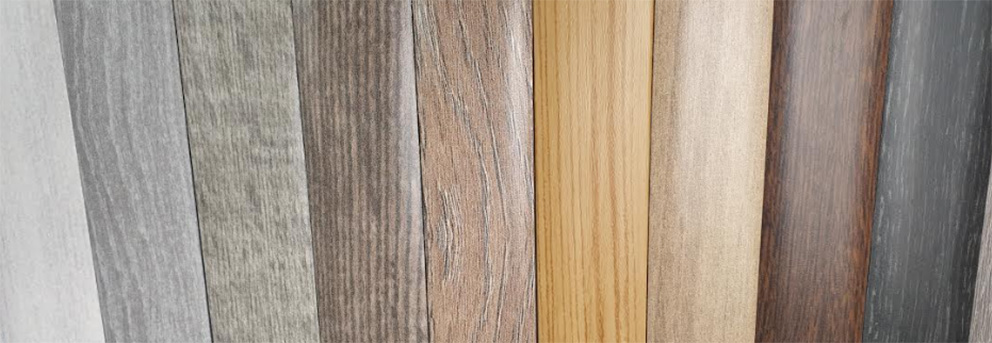
The easiest approach is to match your laminate flooring accessories to your floor. Most laminate ranges have a corresponding door bar and scotia colour – look for bars matched by colour tone (light, medium, grey, dark).
If you cannot find a close match from photos, send us a small offcut of your flooring. We will check it against our full range and send you a photo of the closest match before you order. This is a free service and means you are not guessing from screen colours. Find out more on our About Us page.
The Laminate Flooring Accessories Fitting Kit
A laminate fitting kit is worth having before you start. A standard kit includes spacers for maintaining the expansion gap while you lay, a tapping block for closing the click joints without damaging the edge, and a pull bar for pulling the last boards into place against the wall. Most kits cost just a few pounds and make the job noticeably easier – a small outlay that saves a lot of frustration on the day. The Health and Safety Executive also recommends appropriate dust protection when cutting laminate indoors – fine HDF dust can be harmful when inhaled.
Ready to Order?
We stock over 1,000 door bars in 20 colours and multiple profiles, plus matching scotia beading and radiator pipe covers – everything you need to complete your laminate flooring accessories in one order.
If you know what you need, browse the range below. If you are not sure, call us on 01803 416410 or email sales@aiafa.co.uk.


Comments are closed.