




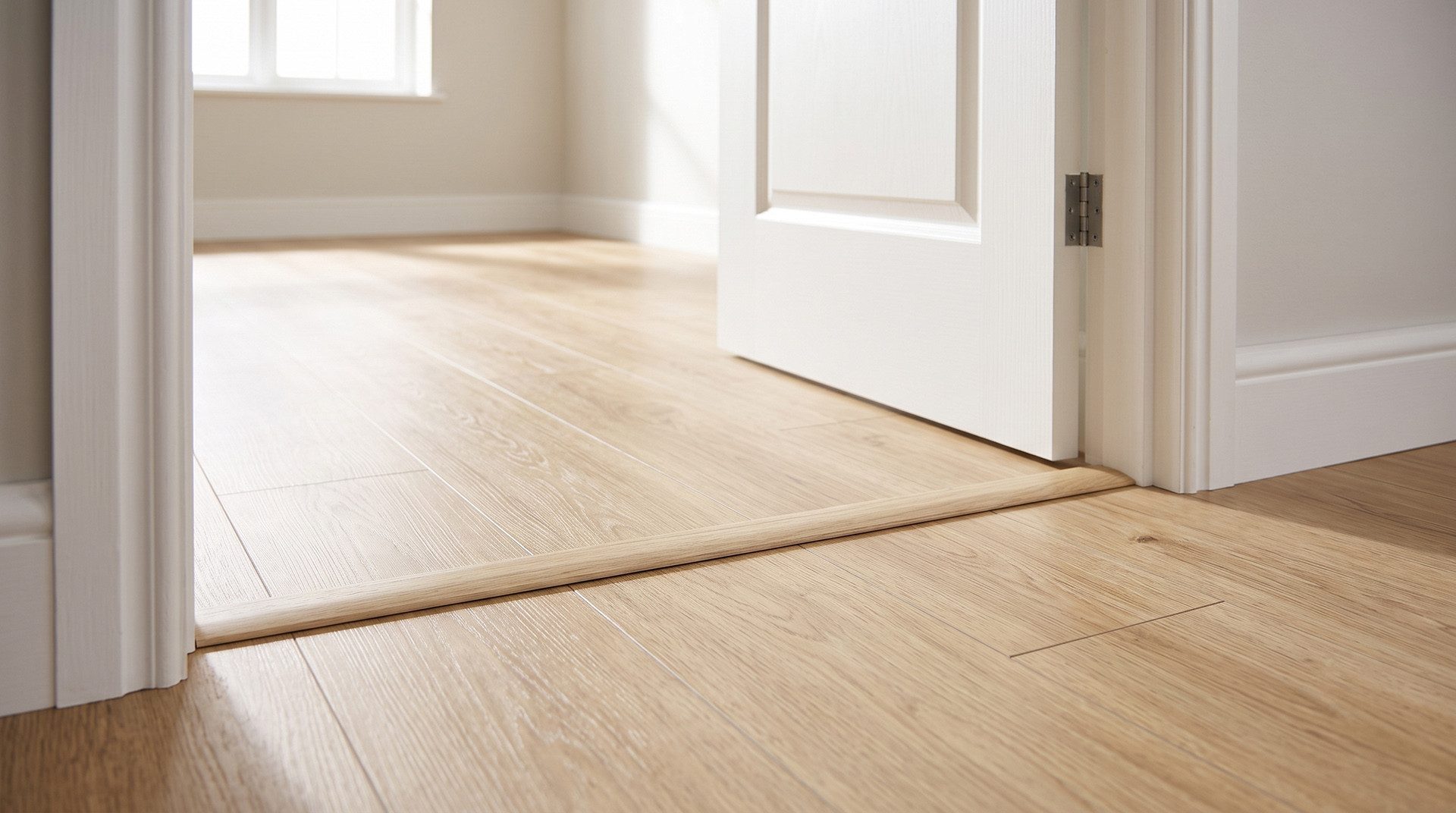
You have spent weeks choosing the floor. You thought about the colour, the board width, the underlay. Then, ten minutes before the fitter arrives, you realise you have not given a second thought to the door threshold strip. It is the small piece of trim that covers the join between your new floor and whatever is in the next room – and it is the detail most people get wrong.
This guide covers every profile we stock, which material suits which floor, how to measure and fit correctly, and where the common mistakes hide. Everything here draws on over 30 years of combined trade experience across our team at All-in-All Flooring Accessories, and every recommendation is something we actually stock and have fitted ourselves.
Jump to Section
- The Short Version
- What is a Door Threshold Strip?
- Door Threshold Strip Profiles – How to Choose the Right One
- Door Threshold Strip Materials We Stock
- Self-adhesive vs Track-fitted – Which Should You Choose?
- How to Fit a Door Threshold Strip in Five Steps
- Common Door Threshold Strip Fitting Mistakes
- Our Free Colour Matching Service
- What to Expect When You Order
- Frequently Asked Questions About Door Threshold Strips
The Short Version
If you want the quick answer before reading the full guide, here is the cheat sheet:
- Same-height floors: T-bar, or flat profile for a lower look.
- Small height difference (laminate/LVT floors, 4-12mm): laminate or SA ramp bar.
- Larger height difference (wood floors, 17-27mm):solid oak ramp bar.
- Carpet meeting tile or hard floor: Z-bar (pick the right height range for your carpet thickness).
- Floor finishing at a fireplace, front door, or back door with no floor on the other side:end profile or L-shape.
- Bathroom or wet room: WPC waterproof bar, SA wood effect and TA tile effect – not laminate, not solid oak.
- Not sure on the colour: send us an offcut – free matching service, same day.
A good door threshold strip should blend in perfectly or as closes to rather than draw attention to itself. Get the profile right and the colour close, and it becomes part of a floor that looks properly finished from every doorway – the kind of detail that makes the whole job look like it was done by someone who knew what they were doing.
What is a Door Threshold Strip?
A door threshold strip is a length of trim that covers the join between two floors at a doorway. It does three jobs:
- Protects the edges of both floors where they would otherwise chip or fray over time.
- Covers the join and expansion gap at the doorway, protecting the cut edges of both floors.
- Manages height differences between rooms so nobody catches their toe.
You will also hear the same product called door bars, threshold bars, transition strips and floor trims. The terminology shifts depending on who you are talking to.
Door Threshold Strip Profiles – How to Choose the Right One
The profile is simply the shape of the strip and what job it does. Work out which profile you need first, then find it in the material and colour that matches your floor.
T-bar
The standard choice when both floors are the same height – laminate meeting laminate, tile meeting tile. The T shape sits across the join with a small gap underneath that allows the floor to expand and contract freely. If the two floors are level, this is almost always the right answer.
Ramp bar
Used when one floor is higher than the other. The ramp slopes down from the higher side to the lower, bridging the step so feet and furniture wheels do not catch. The height range varies by material – laminate ramp bars cover 4-12mm with track (up to 16mm when glued), self-adhesive ramp bars cover 3-12mm, and solid oak ramp bars cover the larger 17-22mm range with track (up to 27mm glued). Always match the bar to the right material for your floor.
Semi-ramp
A gentler version of the ramp for smaller height differences in the 4-16mm range. Worth noting: the semi-ramp is only available in our solid oak and oak veneered ranges – it is not a profile that exists in laminate or WPC. If you need a semi-ramp for a wood floor, we have it. For laminate, the standard ramp is the right choice.
End profile
Used where the threshold finishes at a fixed object and there is no second floor on the other side – a patio door, bifold door, fireplace hearth, or the front edge of a step down. It caps the exposed cut edge of the floor neatly and protects it from chipping.
Flat profile
A low-profile flat cover strip for same-height joins where you want as little height as possible above the floor. Available in our self-adhesive range and solid oak range – not available in the laminate door bar range. If you are laying laminate and need a flat cover, the T-bar is the closest equivalent.
Z-bar
The Z-bar solves the most awkward single transition in any house – where a carpet edge meets a hard floor like tile, LVT, or wood. One side of the Z grips the carpet edge, the other sits flat on the hard floor. You get a tidy join without gluing the carpet down, and the carpet can still be stretched or replaced later without disturbing the threshold. We stock tile effect Z-bars in two height ranges: 2-6mm and 6-10mm, both in 2.7m lengths. We also stock silver and gold Z-bars in 9mm for a more neutral finish.
L-shape nosing
The L-shape does the same job as an end bar – it finishes a floor edge where there is no second floor on the other side. It works well at front doors, back doors, fireplace hearths, and as a room border where the floor meets a fixed object. Where an end bar gives a flat cap to the edge, the L-shape wraps slightly further over the cut edge, which some situations suit better depending on the floor and the profile of the threshold.
Door Threshold Strip Materials We Stock
Once you have the right door threshold strip profile, the next step is to choose the material that matches your floor type and situation.
- Laminate – our most affordable range. Made to our own specification in 20 colours, 0.9m and 2.4m lengths. T-bar, ramp and end bar profiles. Stair nosings available in 1.0m (original range) and 1.2m (newer range) – check individual listings for current stock.
- Solid oak – our premium range. Real European and American white oak, prefinished in 26 colours plus one unfinished option for staining at home – 27 colours in total. Track-fitted, sturdy underfoot, and the bar can be unclipped and replaced without lifting the floor. T-bar, ramp, end bar, semi-ramp (Lacquered Oak and Unfinished only), and flat bar (Lacquered Oak and Unfinished only, 2.4m only) in 0.9m and 2.4m lengths.
- WPC waterproof bars – 100% waterproof throughout, designed for click vinyl and LVT floors in kitchens, bathrooms, and wet areas. Over 60 colours, 1.1m and 2.2m lengths. T-bar, ramp, end bar, L-shape stair nosing and stair nosing profiles.
- Self-adhesive (wood and tile effect) – aluminium with peel-and-stick backing. No track, no screws, no drilling. Wood effect in 32 colours, tile effect in 25 colours, both in 2.7m lengths. Ramp, flat, and L-shape profiles. SA bars are suitable for hard floors – they will not bond to carpet.
- Oak veneered – real oak veneer over an MDF core. Looks identical to solid oak once fitted, costs less. T-bar, ramp, semi-ramp and end bar available. Not suitable for wet areas as the MDF core can be affected by moisture.
Self-adhesive vs Track-fitted – Which Should You Choose?
The honest answer, in fact, depends as much on the floor you are matching as on how you want to fix the bar.
Self-adhesive bars work well on same-height floors and smaller height differences alike, across LVT, laminate, click vinyl, and engineered floors. No drilling, no track, no mess – peel, press, done. In the same way, solid oak and oak veneered bars are not limited to wood floors either – they can be used on laminate and click vinyl too if that is the finish you prefer. You might choose self-adhesive because it is a little easier and quicker to fit than a track-fitted or pin-and-glue bar – a faster solution that is still extremely popular.
Track-fitted door threshold strips are the right choice for engineered wood and solid wood floors. Customers who have invested in a quality wood floor generally want a solid oak bar to match – the finish looks right and reflects the value of the floor underneath. Track-fitted bars can be screwed, glued and pinned, or fixed with a strong grab adhesive and weighted down while it sets. The extra work is worth it for a floor that costs significantly more per metre.
How to Fit a Door Threshold Strip in Five Steps
Fitting correctly is a 10-minute job once you have the right bar and the right tools – if it’s your first time doing this, allow a bit longer while you get used to handling the saw and the track. Here is how to do it.
- Measure the door opening between the door stops on each side – that is your cut length. If the bar needs to clear a door stop profile, nick the corners with a saw.
- Cut to length with the right blade. Laminate, engineered wood, and solid oak bars: mitre saw or jigsaw. Aluminium bars (SA, T-bar, and carpet bar ranges): hacksaw or mitre saw. The Health and Safety Executive recommends appropriate dust protection when cutting flooring materials indoors – a dust mask and open windows as a minimum.
- Dry fit first. Drop the strip into place without fixing to check it sits straight and in the right position before committing.
- Fix it. Track-fitted: screw or glue the track to the subfloor, then clip the door threshold strip in. Self-adhesive: wipe the subfloor with a damp cloth, dry off with a dry cloth, peel the backing, position the strip and press down firmly for 10-15 seconds.
- Allow for the expansion gap. Overall, laminate, engineered wood, solid wood, and WPC boards all need a minimum 10mm expansion gap around the perimeter – including at doorways. SPC vinyl click is more stable and 3-5mm is generally sufficient. Most profiles are designed to sit over this gap, hiding it underneath. If your profile does not accommodate the gap, you have the wrong bar for your floor type. More detail on expansion gaps and building regulations for ground floor installations at the Planning Portal.
Common Door Threshold Strip Fitting Mistakes
Specifically, these are the door threshold strip fitting mistakes we see most often on real jobs.
- Wrong profile for the situation. A T-bar where you needed a ramp, or an end bar where you needed a T-bar. The result is a strip that looks wrong and does not protect the floor edge properly.
- Strip cut too short, then filled with caulk. Measure twice, cut once, and order one bar longer than you think you need. You can always trim, you can never stretch.
- Self-adhesive strip pressed onto a dusty subfloor. It will fail immediately. Wipe the surface with a damp cloth, dry it off, then stick.
- Stair nosing fixed only at the ends. The middle still takes the full weight of every footstep. Use the full set of fixings specified for that profile.
Our Free Colour Matching Service
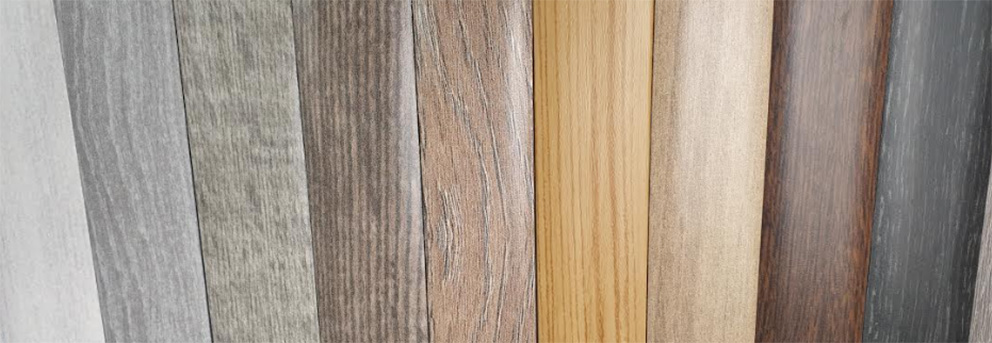
Matching wood tones on your door threshold strip from a photo is unreliable. Two screens showing the same image look different, and returning a 2.4m bar because the colour was off is slow and expensive. Here is how our free colour matching service works:
- Please send an offcut of your flooring.
- Post it to Molly or Sean at All-in-All Flooring Accessories, Manor Avenue, Paignton, TQ3 2HR – include your name, address, contact details, and the profile you need. If you are not sure which profile, do not worry, we can help with that too.
- We photograph the closest match from our full range and email the photo back the same day your sample arrives.
If you are near Devon, our Paignton trade counter is open Monday to Friday (7am-4pm) – bring the offcut in and take the matching bar away the same day.
What to Expect When You Order
Here is what to expect when you order:
- Same-day despatch on orders placed before 12pm Monday to Friday – please allow up to 72 hours for delivery to UK mainland.
- Free UK delivery on orders over £99 excluding VAT.
- Short bars up to 1.2m: £12 inc. VAT. Long bars 2.2m-2.7m: £29.99 inc. VAT.
- Free trade accounts – trade and wholesale account holders get discounted prices with no minimum order. Dropshipping is also available, for trade accounts only.
Call us on 01803 416410 or email sales@aiafa.co.uk if you are not sure which profile or colour to order. We would rather spend five minutes on the phone talking you into the right bar than sell you the wrong one.
Frequently Asked Questions About Door Threshold Strips
What is the difference between a door threshold strip and a door bar?
Nothing – they are the same product. Door bar is the trade name, door threshold strip is the longer term people tend to search for online. We use both on our product pages, and so do most other suppliers.
Do I need a door threshold strip at every doorway?
Yes – all hard floors need a door threshold strip at doorways, not just floating floors. In particular, laminate, engineered wood whether floated, glued, or nailed, solid wood, and click vinyl all need an expansion gap at doorways and the bar covers and protects that edge. Even in rare cases where two identical floors run continuously through a doorway, the strip still protects the exposed cut edges of both floors from chipping over time.
How do I choose the right profile?
Same height on both sides: T-bar. Height difference between rooms: ramp. No second floor on the other side (patio door, hearth, front or back door): end profile or L-shape. Carpet meeting hard floor: Z-bar. However, if you are still unsure, send us a photo of the doorway and we will talk you through which profile fits.
Can door threshold strips be painted?
You can paint a primed MDF strip if you want to match a specific colour. For solid oak, we would recommend oiling rather than painting instead – it keeps the natural grain visible and is easier to maintain and touch up over time than a painted finish. Aluminium and laminate strips do not take paint reliably. Honestly, buying the right colour from the start is usually easier: 20 colours in our laminate range, 27 in solid oak, 32 in self-adhesive wood effect. As a result, there is almost always a close match without the extra work.
How do I colour match a door threshold strip?
Send us a small offcut of your flooring (5cm is enough) with your name, address, contact details, and the profile you are after – addressed to Molly or Sean at All-in-All Flooring Accessories, Manor Avenue, Paignton, TQ3 2HR. We will then photograph the closest match from our full range and email it back the same day. Free, no minimum order.
What are the delivery costs for door threshold strips?
Short bars up to 1.2m are £12 inc. VAT via standard courier. Long bars from 2.2m to 2.7m are £29.99 inc. VAT via specialist long-length courier. Orders over £99 excluding VAT qualify for free UK delivery. Same-day despatch on orders placed before 12pm Monday to Friday – please allow up to 72 hours for delivery. No delivery to Northern Ireland.
Is there a trade account available?
Yes – free to open, no minimum order. Trade and wholesale account holders get discounted prices from day one, and dropshipping is available for trade accounts only. Call us on 01803 416410 or email sales@aiafa.co.uk to get set up.
Comments are closed.